admin
admin
来源:钛媒体
Goldman Sachs Group Inc. reportedly suspended a planned $1.3 billion mortgage-bond sale for CyrusOne, the datacenter operator behind CME Group Inc.’s primary hub, following a massive outage that crippled one of the world’s largest derivatives exchanges over Thanksgiving weekend.
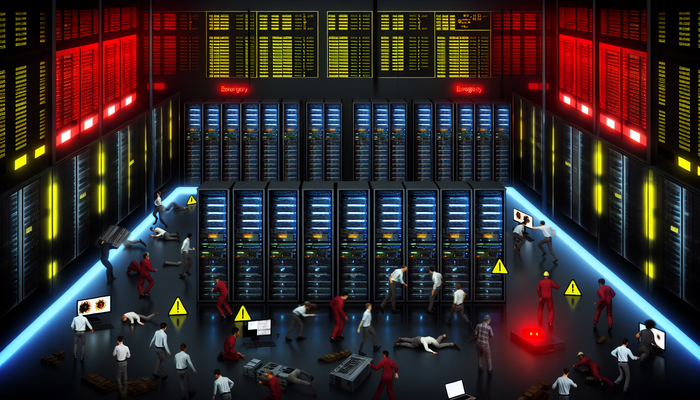
The bank had been managing what would have been CyrusOne’s largest-ever commercial mortgage bond sale, with early feedback due on November 25. Days later, CME’s global markets went dark for more than 10 hours due to a cooling system failure at the Aurora, Illinois facility, which serves as the backbone for trillions of dollars of derivatives traded daily.
The refinancing deal for CyrusOne, owned by private equity company KKR & Co. and infrastructure investment fund Global Infrastructure Partners (GIP), is now on hold after initially being set to price this week, Bloomberg reported Thursday citing anonymous sources familiar with the matter. The transaction may be revived in the first quarter, the sources said.
The debt was secured by a campus of three datacenters in Aurora, about 35 miles outside downtown Chicago. CME accounted for about 14% of the underwritten total rent on the deal, making it the second-largest customer at the campus. Representatives for Goldman Sachs, GIP, and KKR declined to comment, while spokespeople for CyrusOne and CME did not respond to requests for comment.
Critical Infrastructure Failure Exposes AI Investment Risk
The equipment failure has become a wake-up call for investors who have poured hundreds of billions of dollars into the artificial intelligence (AI) datacenter boom, serving as a reminder that facilities’ lease agreements are indeed breakable. Many leases include termination clauses that can be invoked in the event of multiple recurring outages.
CyrusOne’s suburban Chicago datacenter announced it has since bolstered its backup cooling capacity following the overheating that caused Friday’s meltdown. Temperatures at the complex soared above 100°F (38°C) during the outage, despite frigid weather outside, Bloomberg reported.
While CME’s disaster recovery plan involves moving operations to a datacenter in the New York area, the exchange opted not to switch to the backup facility, as initial information suggested the Aurora outage would be brief. Instead, the disruption resulted in one of the longest unplanned outages in CME’s recent history.
Governance Gaps in Modern Datacenter Operations
Sanchit Vir Gogia, chief analyst at Greyhound Research, described the CME outage as “a case study in how a single physical failure inside a datacenter can escalate into a global market disruption when governance, failover logic, and environmental engineering are not aligned with the realities of modern infrastructure.”
The fundamental issue was not only that a cooling plant malfunction knocked out multiple chillers simultaneously, but also that backup systems failed to operate independently, Gogia explained. The rapid temperature spike made it impossible for CME to keep matching engines online, with thermal failures escalating within minutes rather than following traditional disaster recovery timelines.
John Annand, senior technical counselor at Info-Tech Research Group, highlighted risk management failures during the incident. “At some point, the CME Group Incident Commander decided that rather than failing over to their secondary site, it was better to let CyrusOne continue to attempt to fix the problem primarily,” he said. “That choice turned what might have been a minor disruption into an open-ended outage lasting some 10 hours.”
PE-Owned Datacenter Under Scrutiny
The Aurora complex, which reportedly handles at least $25 quadrillion of notional trade volume daily (according to a 2018 estimate), dates back to 2009 when CME began building the facility. In 2016, CME sold the site to Dallas-based CyrusOne and agreed to rent space for 15 years, outsourcing day-to-day operations.
In 2021, KKR and Global Infrastructure Partners acquired CyrusOne in a deal worth roughly $11.4 billion, capitalizing on surging AI-driven datacenter demand. According to CyrusOne’s website, the datacenter includes additional chiller units intended to protect against failures, raising questions about the cause of last week’s outage.
Thomas Solelhac, a partner at EY-Parthenon, suggested the cooling failure might indicate a design flaw. “Normally, in datacenters of this type, there is a lot of redundancy to avoid this kind of problem with power and cooling,” he said.
特别声明:以上内容仅代表作者本人的观点或立场,不代表新浪财经头条的观点或立场。如因作品内容、版权或其他问题需要与新浪财经头条联系的,请于上述内容发布后的30天内进行。
https://finance.sina.com.cn/cj/2025-12-05/doc-infztinh8489704.shtml